
When closing volume grows, adding headcount can feel like the obvious way to keep up. More files mean more verification, more phone calls, more payment coordination, more follow-ups, and ultimately, more work for the closing team.
But hiring isn’t the only way to create more capacity.
Improving title company efficiency starts with looking at how much of the existing team’s time is being consumed by repetitive, manual work. When those tasks are reduced or automated, teams can create meaningful capacity without automatically adding another person.
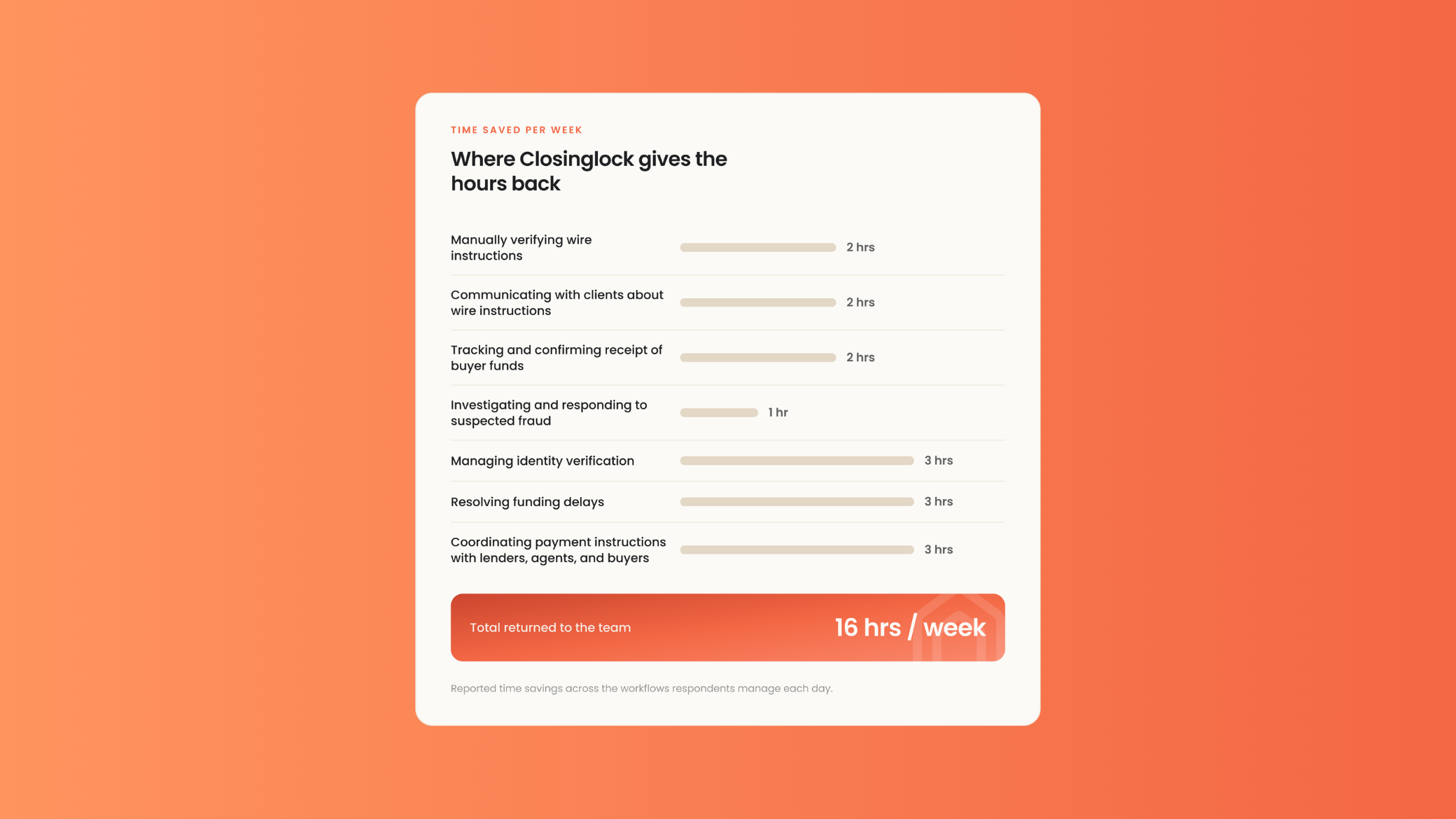
In new research among Closinglock customers, respondents reported saving 16+ hours of work every week. The bigger story is what title teams can do with that time.
Where are title teams losing capacity?
A few minutes here. A phone call there. Another email. Another follow-up.
Many of the tasks that consume a title team’s day don’t look particularly significant on their own. But multiply them across every file, every employee, and every week, and they become a meaningful drain on capacity.
Verification calls, payment coordination, client follow-ups, switching between systems, and other repetitive administrative tasks all require time and attention. When these processes are fragmented, employees may also spend time tracking down information or moving between different tools just to complete a single workflow.
For a busy title team, improving the title company workflow isn’t just about making individual tasks faster. It’s about reducing how many manual touches are required in the first place.
How can title companies increase capacity without adding headcount?
Title companies can create more capacity by reducing repetitive manual work, consolidating fragmented workflows, and automating appropriate steps in the closing process. This allows existing employees to spend less time on administrative tasks and more time moving transactions forward, supporting clients, and handling work that requires their expertise.
That distinction matters.
Efficiency isn’t simply asking the same team to work faster. It’s removing unnecessary work from their plates.
In Closinglock’s ROI research, customers reported saving 16+ hours of work every week. For a team trying to accommodate more closing volume, getting that time back creates another option besides immediately adding headcount: making more room within the team you already have.
What does getting 16 hours back every week make possible?
Sixteen hours is two full eight-hour workdays.
But the real value isn’t the number of hours itself. It’s what a title team can do with them.
Getting time back can mean more capacity to manage files, more time to communicate with clients, and more attention for work that actually requires human judgment. It can also give growing title companies more flexibility before another hire becomes necessary.
The research found that customers were able to scale transaction volume, redirect employees toward higher-value work, and in some cases delay or avoid additional hiring.
As Kalynn Rose, Software Administrator & Trainer at Olympic Peninsula Title, explained:
“We used to have four different people completing different things. With Closinglock, I can just have one person and an automation handle it.”
That’s why the 16-hour finding is ultimately bigger than a productivity metric. Time saved becomes capacity the business can put somewhere else.
78% of respondents say their clients ask directly how their funds are protected.
How can technology improve closing efficiency?
Technology can improve closing efficiency by reducing repetitive administrative work, standardizing workflows, and minimizing the number of manual handoffs required to move a transaction forward. The goal should not simply be to digitize existing processes. It should be to remove unnecessary work.
For title teams, that means looking closely at the workflows employees repeat across every transaction. Verification calls, payment coordination, follow-ups, data entry, and switching between disconnected systems may only take a few minutes at a time, but that time compounds as transaction volume grows.
The right technology can help consolidate those workflows and automate appropriate steps while maintaining the controls needed to protect the transaction.
That creates a better equation for growing title teams: more capacity without asking employees to simply work more.
More capacity starts with less unnecessary work
Growth doesn’t always have to mean adding more people.
For title leaders, the first question can be simpler: How much capacity is already sitting inside the work your team is doing today?
Reducing repetitive verification, follow-ups, payment coordination, and fragmented workflows can give employees meaningful time back. That creates more room for closings, clients, and higher-value work.
Closinglock’s new ROI research looks at how modern title teams are protecting transactions in 2026, including the impact on time, closing speed, fraud prevention, and business capacity.