
More verification steps. More identity checks. Another layer of protection to click through before money moves. For many title teams, stronger security sounds like it should come with a trade-off: a slower, more cumbersome real estate closing process.
That assumption makes sense on the surface. Security has traditionally meant more friction, more phone calls to confirm details, more manual checks, more back-and-forth before funds are released.
But new research on Closinglock customers tells a different story. Customers reported closing nearly 20% faster on average while also using the platform to strengthen identity verification and fraud prevention.
Why security and speed feel like a trade-off
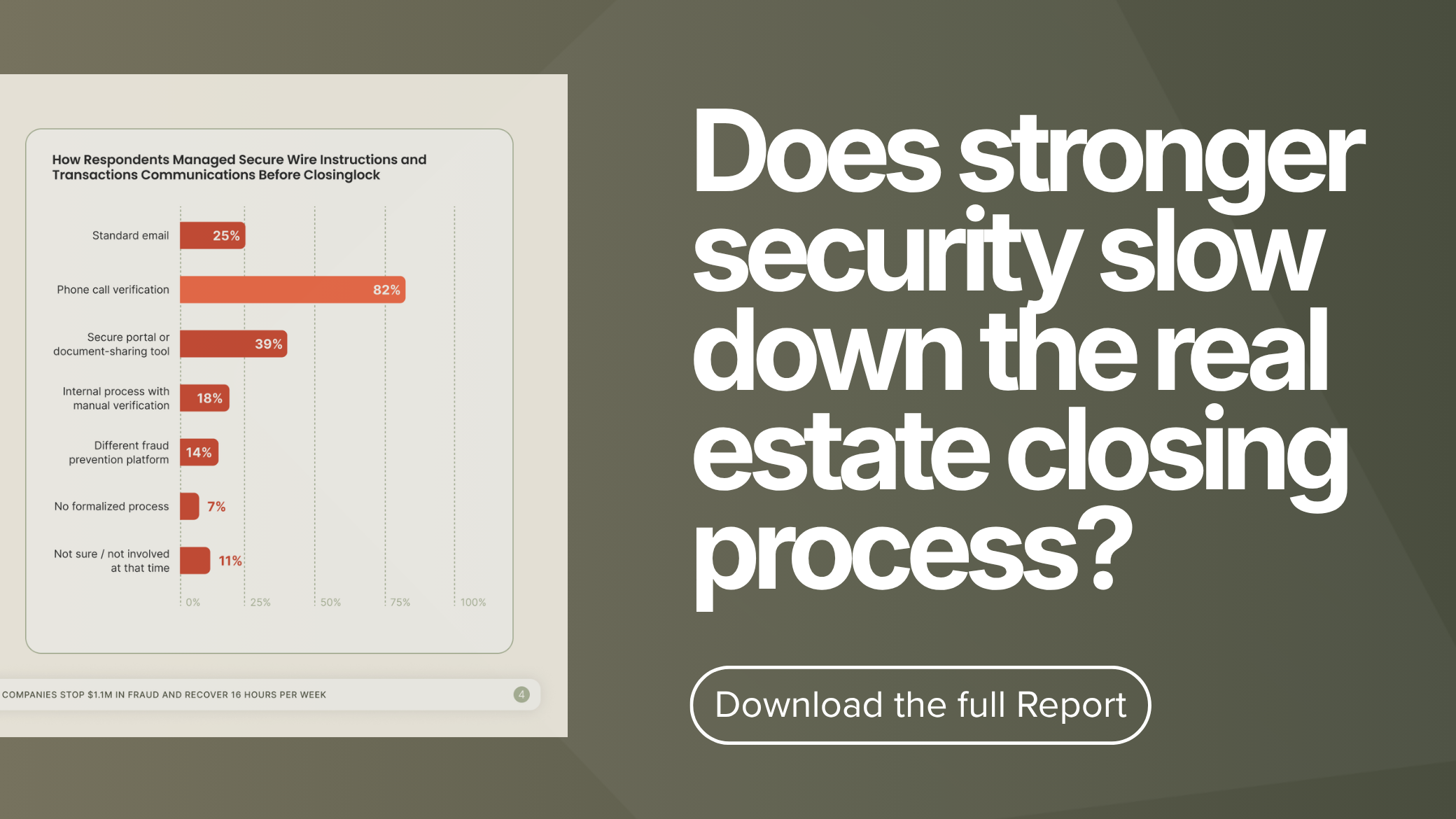
Before adopting a platform like Closinglock, most firms were piecing together their own secure closing process, combining standard email, phone calls, secure portals, and manual verification. In new research, 82% of respondents said phone verification was part of that process, and 25% still relied on standard email for wire-related communication.
Each of those methods takes time. Phone verification means playing phone tag or sitting on hold. Manual checks mean an employee stopping other work to confirm a detail by hand. Secure portals and document-sharing tools help, but when they’re layered on top of an already fragmented title company workflow rather than built into it, they add another step rather than replacing one.
It’s easy to see why “more security” and “more time” started to feel like the same thing.
Does stronger security slow down the real estate closing process?
Not necessarily; when it does, the slowdown may come from how security is handled rather than from the security itself. Closinglock customers who consolidated identity verification, wire instructions, and payments into one platform reported closing nearly 20% faster on average.
Manual steps, disconnected tools, and follow-up calls can all create friction in the closing process. When those workflows are brought together, title teams can strengthen protection while reducing some of the manual work surrounding it.
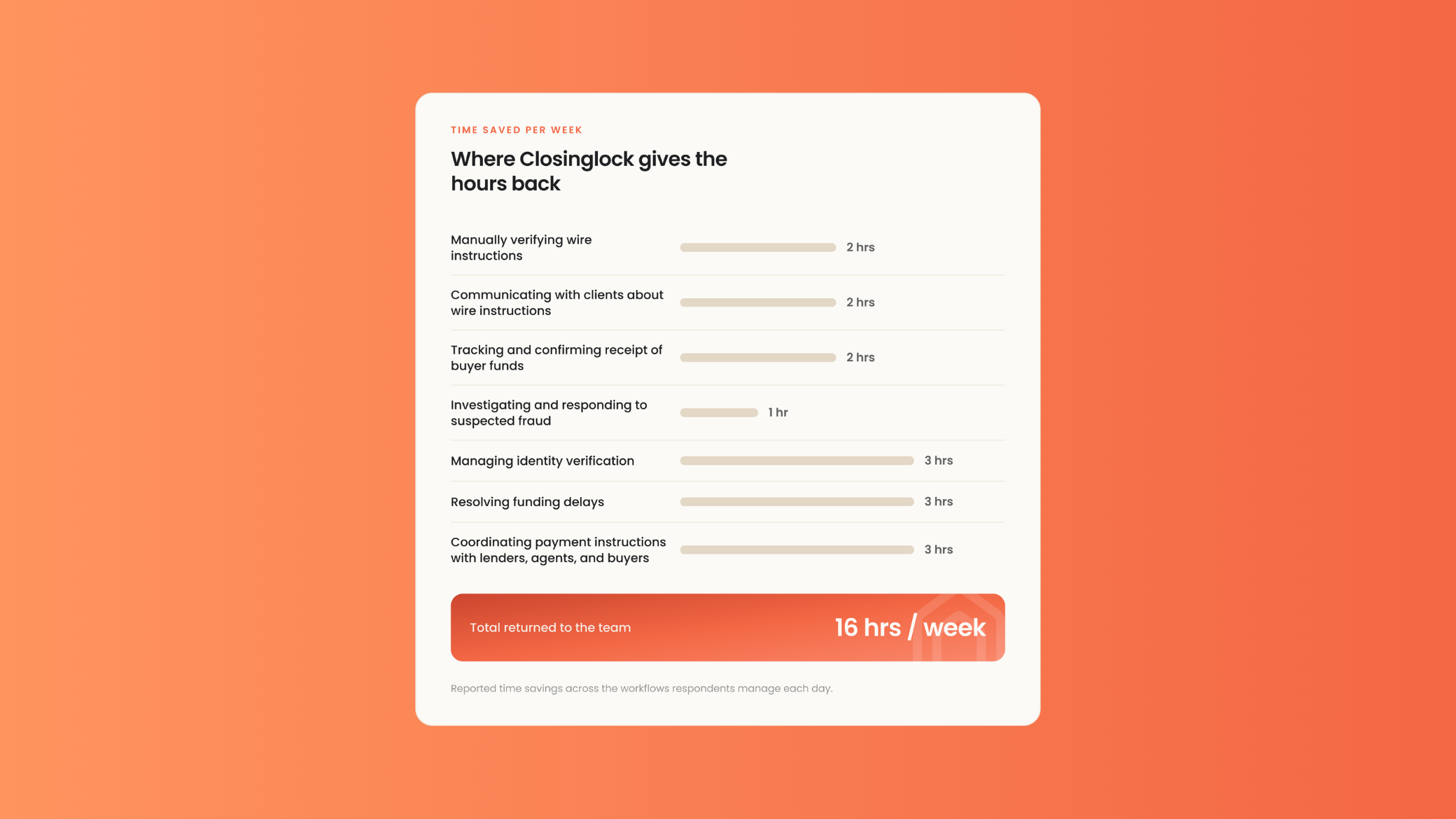
Nearly three-quarters of respondents (74%) also said the platform contributes to a smoother closing experience, and customers reported saving 16+ hours a week on top of the speed gains. For title teams, closing efficiency isn’t simply about asking the same team to move quicker. It’s about reducing the manual work that can slow a closing down.
What’s actually driving faster closings
Faster closings often come from removing friction, not removing protection. Look at the steps teams repeat across every transaction: verifying account information, exchanging wire instructions, confirming identities, collecting signatures, and following up with clients. When those processes rely on separate calls, emails, and systems, each handoff creates another opportunity for delay.
The opportunity is to build security into the workflow itself, so verification happens as part of the closing process rather than as an additional layer around it.
Kalynn Rose, Software Administrator and Trainer at Olympic Peninsula Title, described what that shift looked like in practice: “Before Closinglock, I had to sit on the phone and go through three different automated systems just to reach a person. Now, I just plug in loan wire information and get an instant verification.”
Closinglock customers’ reported speed gains show what that can look like in practice: less time spent navigating manual verification steps and more efficient ways to move a transaction forward.
A fragmented closing process creates its own friction
Adding more tools doesn’t necessarily create a more secure or efficient closing. When verification, communication, payments, and other steps happen across disconnected systems, teams still have to move information between them and manage the handoffs.
The more useful question isn’t simply how many security measures are in place. It’s whether those protections are built into a workflow that makes it easier for teams to do the right thing consistently.
Security and speed don’t have to compete. When protection is built into the closing workflow instead of layered on through additional manual steps, title teams can reduce friction without cutting corners.
And closing speed is only one part of the equation. Closinglock’s new ROI research looks at what happens when title teams reduce friction across the closing process, from the time teams get back each week to the fraud exposure they reduce and the additional capacity they create.
See the full business impact in What protection is worth: The ROI of Closinglock